Quick Answer
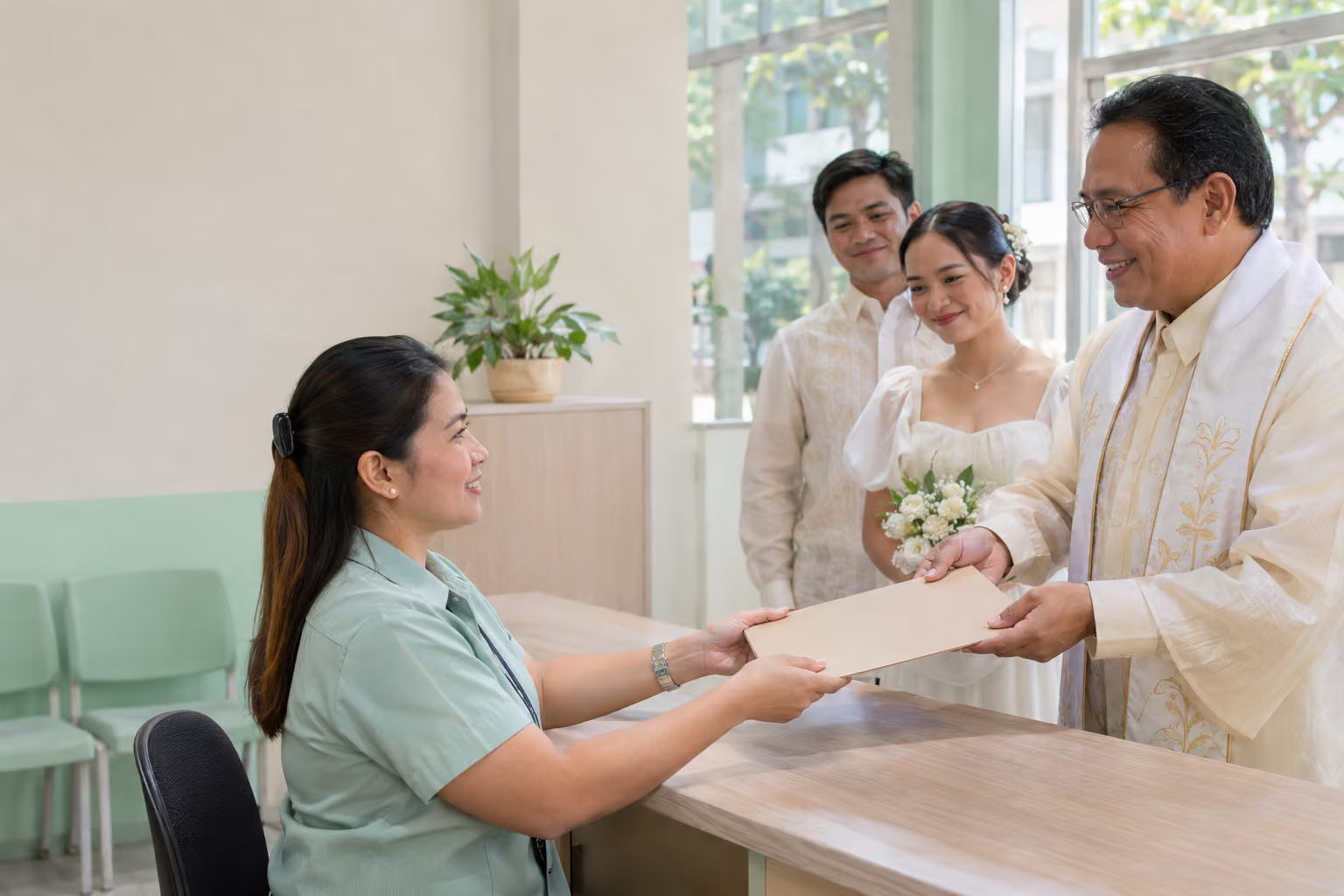
After an ordinary Philippine marriage, the solemnising officer sends the marriage-certificate copies to the local civil registrar for the place of the ceremony. The Family Code requires transmission within fifteen days. Local registration and the later availability of a PSA-issued copy are separate stages, so signing the certificate does not mean the national record can immediately be ordered.
Keep the couple’s certificate copy and establish how to trace the officer’s filing.
The record moves through distinct stages
| Stage | Main responsibility | Useful evidence |
|---|---|---|
| Ceremony and signatures | Couple, witnesses and solemnising officer | Correctly completed marriage certificate |
| Transmission | Solemnising officer under the ordinary Family Code process | Filing or delivery details |
| Local registration | Registrar where the marriage occurred | Registry reference and local certified copy |
| Endorsement or transmission to PSA | Local registry and the relevant PSA channels | Transmittal or endorsement details |
| National copy issuance | PSA once the record is available | PSA-issued marriage certificate |
The stages can involve different offices and dates. An appointment receipt from before the wedding proves none of the later transmission steps by itself.
Which registrar receives the certificate?
The relevant place is where the marriage was solemnised.
That can differ from the locality that issued the licence, because a valid licence can be used nationally. A couple who applied in one city and married in another should identify the registrar for the actual ceremony location.
The local-versus-PSA certificate guide explains the records issued at the different levels.
Do not ask an unrelated registrar to create a duplicate registration simply because its office is nearer.
Who must submit it, and by when?
Article 23 assigns the ordinary transmission duty to the solemnising officer. It also requires the officer to provide either contracting party with the original certificate referred to in Article 6 and provides for registrar receipts.
The PSA’s registration guidance distinguishes the ordinary fifteen-day reporting period from thirty days for licence-exempt marriages. Particular personal-law or exceptional marriages can have their own prescribed reporting route.
These are filing periods, not promises that the PSA will release a national certificate within fifteen or thirty days after the wedding.
The officer’s duty also does not mean the couple should lose all means of tracing the file. Establish the office handling submission and retain the available reference.
The Supreme Court’s published wedding service tells applicants to handle local filing unless the Justice’s office agrees to process it. Where that service is used, establish the practical filing arrangement expressly; do not assume office staff will transmit the record without coordination.
Check the marriage certificate before it travels
A preventable error is easier to identify while the participants and supporting documents are available.
Review names, citizenship, residence and personal particulars, the actual ceremony date and place, licence information or exemption basis, and the officer and witness details.
If a mistake is found after signing or registration, use the appropriate correction procedure. Our guide to correcting a marriage-certificate error explains why retyping a replacement without the proper process is not an adequate solution.
The record must reflect the real event. Neither a later ceremony date nor a different venue should be inserted to fit an administrative preference.
Obtain evidence of local registration
Ask the appropriate registrar whether the certificate has been received and registered. Where available and required, obtain a certified local copy and registry reference.
A registry number helps identify the entry. It does not by itself establish that the PSA has already incorporated the document into its copy-issuance system.
Keep the distinction clear when a receiving authority asks specifically for a PSA certificate. A local certified copy can be official evidence while still being the wrong required format for that transaction.
How does the record reach the PSA?
Local registrars have statutory duties to compile and transmit civil-registry entries. The national record then needs the appropriate processing before copy issuance.
The PSA also describes electronic endorsement: a document is endorsed through the local and PSA channels, scanned and transmitted for central verification and approval. After approval it can become available for issuance.
This route concerns a real registered record. It is not permission for a couple or private provider to upload any signed document and declare it a PSA certificate.
The guide to PSA certificate availability after the wedding explains the separate timing question.
If the officer has not filed the record
First establish the facts: which office holds the signed copies, whether they were sent, and whether the correct registrar received them.
If the legal reporting period has passed without registration, the delayed-registration procedure may be relevant. Our guide to delayed marriage registration explains the supporting evidence and evaluation.
Do not describe a record awaiting national endorsement as unregistered without checking the local register. Late initial registration and a locally registered record missing from PSA are different problems.
What if both spouses are foreign?
A marriage solemnised in the Philippines still needs the applicable Philippine registration process. The couple’s nationality does not turn the event into a marriage registered only by their home-country embassy.
Later overseas reporting, recognition or use of the certificate is a separate matter. Retain the Philippine record chain so the correct proof can be obtained after leaving.
A registration follow-up checklist
- Retain the couple’s correctly signed certificate copy.
- Identify the officer or office transmitting the record.
- Establish the actual place-of-marriage registrar.
- Obtain local receipt or registration details.
- Check the record’s names and event particulars.
- Trace endorsement to PSA where needed.
- Order the required national copy when available.
- Use correction or delayed-registration procedures only where the facts call for them.
Registration questions
Are we married only when the PSA copy is released?
The ceremony’s legal validity and subsequent record availability are different questions. A delayed PSA result should not automatically be treated as proof that no marriage occurred.
Can registration fix an invalid ceremony?
Civil registration records an event; it does not supply missing substantive or formal legal requirements merely by accepting paperwork.
Should we register the same marriage again if PSA cannot find it?
Establish the existing local record first. Duplicate registration can create another problem instead of solving transmission or indexing.
Plan your next step
Discuss your circumstances and the assistance you need with Marriage Assistance PH.