Quick Answer
A marriage under the Philippine Family Code requires at least two witnesses of legal age to be present for the couple’s declaration. The witnesses also sign the marriage certificate. Legal age is ordinarily 18 under Republic Act No. 6809; choosing adult witnesses is therefore part of preparing a valid ceremony, not simply arranging the guest list.
Article 6 connects their role to what actually happens at the wedding. Signing a document without witnessing the declaration is not the same participation.
What the witnesses must witness
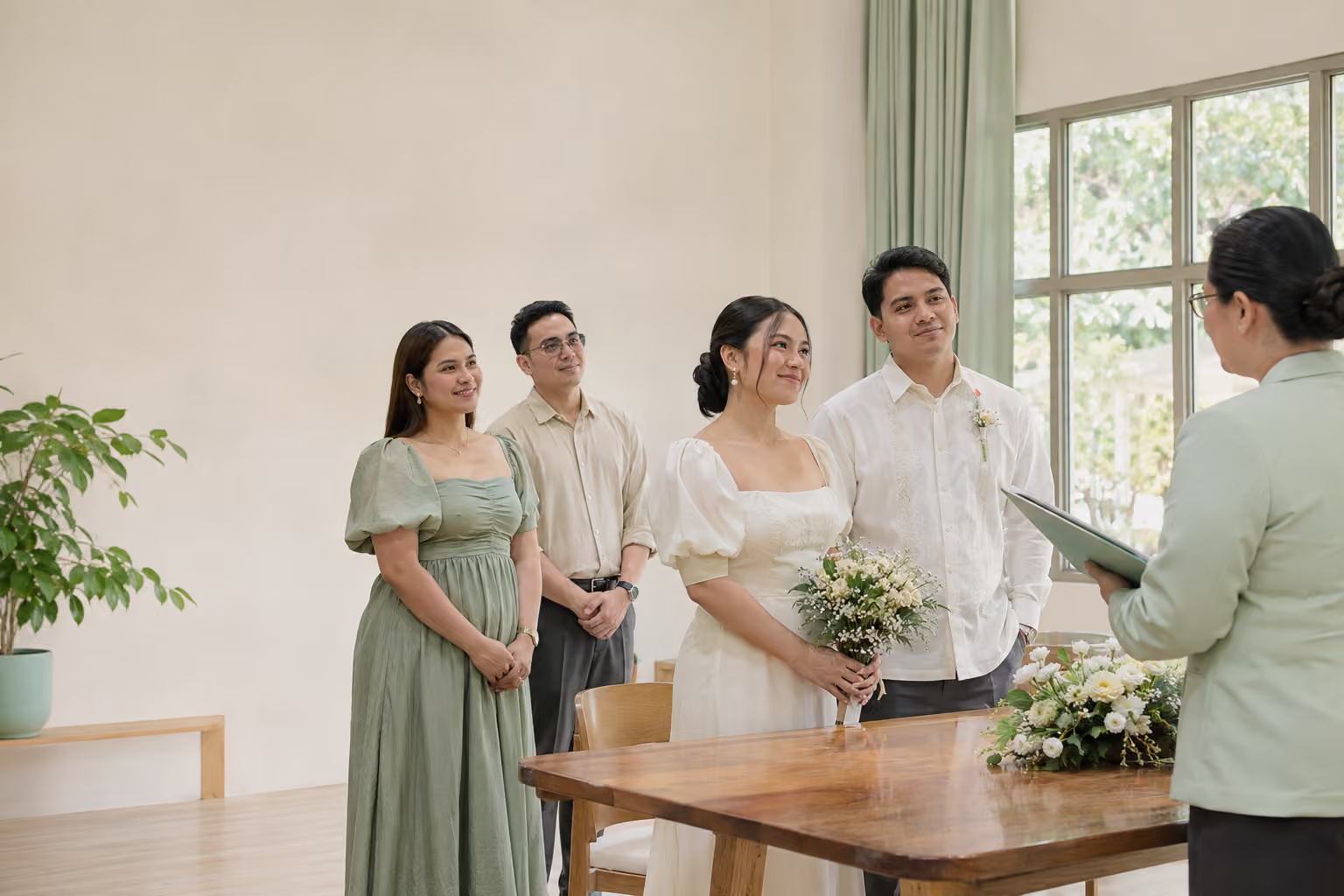
The couple personally appear before the authorised solemnising officer and declare that they take each other as husband and wife. The declaration is made in the presence of at least two witnesses of legal age.
The marriage certificate records that declaration and is signed by the couple and their witnesses, then attested by the officer.
The solemnising-officer guide explains the officer’s separate authority. Two witnesses cannot replace the officer, and the officer’s presence does not remove the witness requirement.
| Requirement | Practical preparation |
|---|---|
| At least two witnesses | Identify two people who can actually attend the ceremony |
| Legal age | Establish that each selected witness is at least 18 |
| Presence at the declaration | Arrange arrival before the legal ceremony starts |
| Certificate signatures | Ensure the people who witnessed the declaration sign the correct record |
| Accurate identity details | Prepare the names and identification requested by the office |
A larger group of guests does not automatically identify which people will serve as the legal witnesses.
Can relatives, friends or foreign nationals act?
The Family Code’s stated witness requirements concern the number, legal age and participation. It does not impose a general requirement in these provisions that a witness be unrelated to the couple or hold Philippine citizenship.
A parent, sibling or friend may therefore be considered, subject to meeting the actual requirements. For a foreign witness, establish the identity document the officer’s office will accept.
Do not confuse this with the witnesses required for a different document, such as a supporting affidavit. A person suitable for one role is not automatically recorded as the ceremony witness.
The couple should give the proposed officer the witnesses’ circumstances early if there is any uncertainty about identification, age or participation.
Identification and information to prepare
The national ceremony provisions do not prescribe one identical photocopy package for every venue. The receiving office may ask for identification and witness details to prepare its forms.
Have each witness check:
- Their full name as it should appear on the record.
- The identity document they will present.
- Any address or other detail requested for the certificate.
- Whether photocopies are required.
- The arrival time and place for signing.
A nickname used socially may not be the correct name for the official record. Resolve spelling before the ceremony rather than allowing someone to guess while the certificate is signed.
The civil wedding-day document checklist puts witness identification alongside the couple’s documents.
Legal witnesses and ceremonial sponsors are different roles
A wedding can have sponsors, attendants, godparents and other ceremonial participants. Those titles do not decide who fulfilled the Family Code’s witness role.
If principal sponsors will also be the legal witnesses, ensure that they attend the declaration and sign the appropriate certificate. A sponsor who cannot attend should not be listed simply to preserve the intended programme.
Religious preparation may involve additional rules or sponsors. Establish them with the relevant institution while keeping the minimum civil witness requirement clear.
Does a licence exemption remove the witnesses?
No general exemption from the ceremony’s witnesses follows merely because a marriage does not require a licence.
The Family Code has specific rules for exceptional circumstances. For example, where a party at the point of death cannot sign, Article 6 allows a witness to write that party’s name, with the fact attested by the officer.
That narrow provision does not permit an ordinary absent applicant to marry through a witness. The guide to marriages without a licence explains the distinct exemption conditions.
Before the wedding
- Select at least two adult witnesses.
- Establish their attendance at the declaration itself.
- Obtain the office’s identity and copying requirements.
- Check the names entered on the certificate.
- Identify an eligible replacement if travel is uncertain.
- Ensure the actual witnesses sign after participating.
Witness questions
Must we hire witnesses?
The Family Code does not require a paid witness service. Choose people who meet the legal requirements and the office’s identity arrangements.
Can a child take the place of an adult witness?
A ceremonial role for a child does not satisfy the requirement for witnesses of legal age.
Can a witness sign later because they missed the ceremony?
A later signature does not make that person present at a declaration they did not witness. Resolve the issue with the officer rather than treating the certificate as an attendance substitute.
Plan your next step
Discuss your circumstances and the assistance you need with Marriage Assistance PH.