Quick Answer
A civil wedding suits couples seeking a non-religious legal ceremony; a church wedding suits couples who also want to marry under a faith’s rules and can meet its requirements. Either can constitute a legally valid Philippine marriage when the applicable civil conditions are satisfied. The choice changes the officer, preparation and ceremony arrangements, rather than removing legal eligibility or licence requirements.
Begin with both partners’ beliefs, marital history and available preparation time. A preferred setting is important, but it cannot decide whether a particular officer or religious body can marry you.
Compare the processes, not just the appearance of the ceremony
| Question | Civil wedding | Church or other religious wedding under the ordinary Family Code route |
|---|---|---|
| Who conducts it? | An authorised public official, such as a serving judge within jurisdiction or a city/municipal mayor | A properly authorised religious officer who satisfies the applicable legal conditions |
| What preparation is involved? | Civil documents, licence where required and the solemnising office’s arrangements | Civil requirements plus the faith’s own marriage preparation |
| Must the couple share a faith? | No religious affiliation is required for the civil ceremony itself | Religious affiliation and mixed-faith rules may affect eligibility |
| Where can it take place? | A lawful venue subject to the officer’s authority and relevant conditions | A venue permitted by both the applicable civil rules and the faith’s requirements |
| Is a licence normally required? | Yes, unless a specific lawful exemption applies | Yes under the ordinary route; a religious label alone does not create an exemption |
| Is the reception part of the legal marriage? | No | No |
The same celebration venue can look suitable for either type of event while being unsuitable for a particular legal or religious ceremony.
Choose a civil wedding for a non-religious legal ceremony
A civil ceremony does not require a prescribed religious rite. Both partners must make the required personal declaration before an authorised officer and at least two witnesses of legal age.
City and municipal mayors have statutory solemnisation powers under the Local Government Code. Judges act within their legal authority and court jurisdiction. The relevant office’s arrangements affect scheduling and venue.
This route may suit a couple whose beliefs differ, who do not wish to have a religious ceremony or who prefer a small legal wedding. It does not bypass a previous-marriage impediment or replace the foreign partner’s legal-capacity evidence.
Our Civil Marriage guide explains how the legal ceremony is arranged.
A church wedding adds a religious assessment
For religious officers covered by Article 7(2) of the Family Code, legal conditions include authorisation by the church or sect, registration with the civil registrar general, compliance with the limits of written authority and the affiliation of at least one partner to that church or sect.
Religious preparation is a separate layer. It can include establishing freedom to marry under that faith’s rules, instruction and the appropriate church permissions. The documents and preparation used by one denomination should not be described as the requirements of every church in the Philippines.
Catholic preparation and mixed-faith marriages
Catholic canon law requires preparation and examination of whether a lawful marriage can take place. An existing marriage bond is a distinct canonical issue; a civil-status document does not necessarily settle it.
Catholic law also distinguishes two situations:
- A Catholic marrying a baptised non-Catholic Christian generally requires the competent authority’s permission under canon 1124.
- A Catholic marrying an unbaptised person raises the impediment addressed in canon 1086; a dispensation is required for a valid marriage under that framework.
These are different procedures. Neither nationality nor a civil marriage licence decides the religious question.
A civil annulment, divorce or declaration of nullity should not automatically be treated as a Catholic determination of freedom to marry. Any necessary canonical assessment must be resolved before treating a church date as confirmed.
Do not assume a religious ceremony is automatically a legal marriage
A person may conduct a blessing or symbolic celebration without having authority to solemnise a Philippine marriage. Establish which part of the event is intended to create the legal marriage, and who is responsible for the official record.
Equally, a licence exemption must rest on the actual legal conditions. It is not created by calling the event a church wedding.
Muslim marriages may fall within the separate scope of the Code of Muslim Personal Laws. That route needs its own assessment and should not be treated as an interchangeable version of an ordinary church wedding. The current prohibition on child marriage also covers religious and customary practices; historic age provisions do not create a present-day workaround.
If you already have a civil marriage
Tell the religious authority that the civil marriage has already taken place. A later religious celebration may involve the faith’s own procedure, including a canonical assessment where applicable.
Do not prepare a second application on the false basis that both people have never been married. The correct civil and religious records need to reflect the existing marriage.
This is particularly important if the couple wants a ceremony anniversary or family celebration that looks like a first wedding. The appearance of the event does not change the underlying civil status.
Make the decision before booking the venue
Work through these questions:
- Do both partners want a religious marriage, and under which faith?
- Can that religious authority marry this couple, including any mixed-faith or previous-marriage issue?
- Who will conduct the legally effective ceremony?
- Which registrar is competent to handle the licence application?
- What personal appointments and preparation are required?
- Is the chosen location permitted for that officer and ceremony?
The guide to where to apply for a marriage licence covers the application office. For a mixed-nationality couple, the Filipino–foreign document guide addresses the civil paperwork shared by either ordinary route.
Keep the ceremony and registration responsibilities clear
Before the wedding, establish the documents required on the day and who will prepare the marriage certificate. Our wedding-day document guide helps identify practical paperwork checks, although a church may also require its own records.
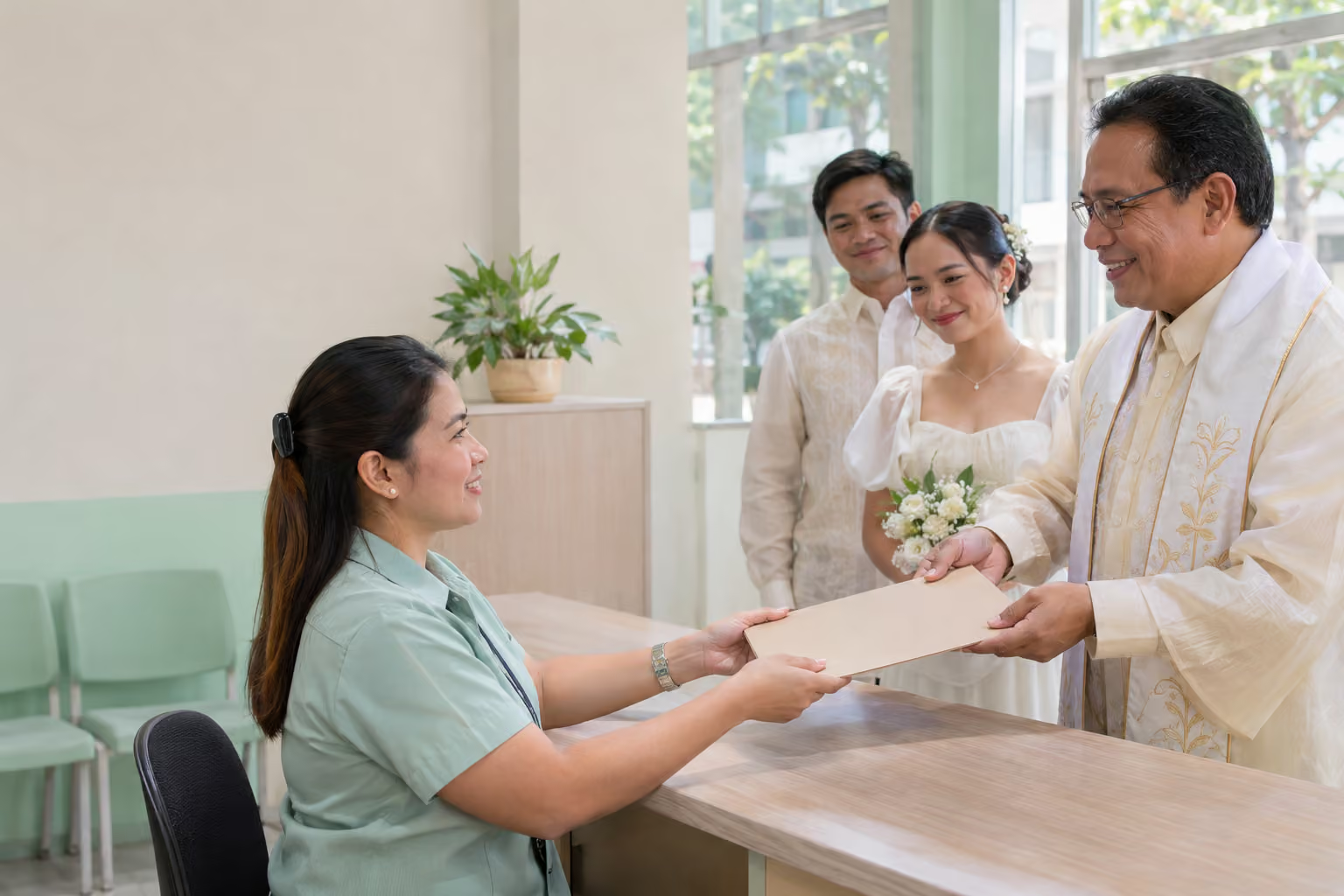
After an ordinary legal ceremony, the solemnising officer has the duty to transmit the marriage record for local registration. A church entry and a PSA-issued marriage certificate are not the same administrative record. The guide to marriage registration after the ceremony explains the next stage.
Questions couples ask when choosing
Is a church wedding legally stronger than a civil wedding?
The Family Code does not create a higher category of ordinary marriage because the ceremony is religious. Legal validity depends on satisfying the applicable essential and formal requirements.
Is a civil wedding always quicker?
Not necessarily. It avoids the particular religious preparation of a church wedding, but document issues, public posting, office appointments and officer availability still affect the schedule.
Can we have a civil ceremony and a reception with religious elements?
Personal readings, prayers or a separate blessing do not by themselves change who solemnises the legal marriage. Make the roles clear so that guests’ experience and the official record accurately reflect what took place.
Plan your next step
Discuss your circumstances and the assistance you need with Marriage Assistance PH.